Collect and prepare
Registration, exhibitor services, catalogue information, invitations, accreditation, floor planning, appointments, readiness checks and stakeholder communication.

Connected data, digital services and intelligent workflows that support exhibition stakeholders across relevant stages of planning, delivery and follow-up.

What it means
A digital exhibition system is the connected information and workflow layer behind relevant exhibition services. It can bring data, responsibilities, status and outputs together across registration, exhibitor services, floor planning, catalogues, badges, invitations, accreditation, meetings, on-site support and reporting.
The objective is not technology for its own sake. It is to make information easier to collect, validate, use, exchange and improve while keeping each stakeholder connected to the part of the process they need.
Connected information
Organisers, venues, exhibitors, visitors, buyers, agents, contractors and service providers do not need the same interface or level of access. They do, however, benefit when their permitted information comes from connected structures rather than disconnected files and repeated manual entry.
A well-planned system can collect information once, reuse it for authorised purposes and present the appropriate view, task or output to each stakeholder.
Exhibition lifecycle
Registration, exhibitor services, catalogue information, invitations, accreditation, floor planning, appointments, readiness checks and stakeholder communication.
Access, badges, service requests, operational information, schedule changes, meetings, support, escalation and relevant live-status visibility.
Feedback, structured follow-up, performance reporting, reusable data, retained knowledge and evidence for improving the next edition.
Workflow automation
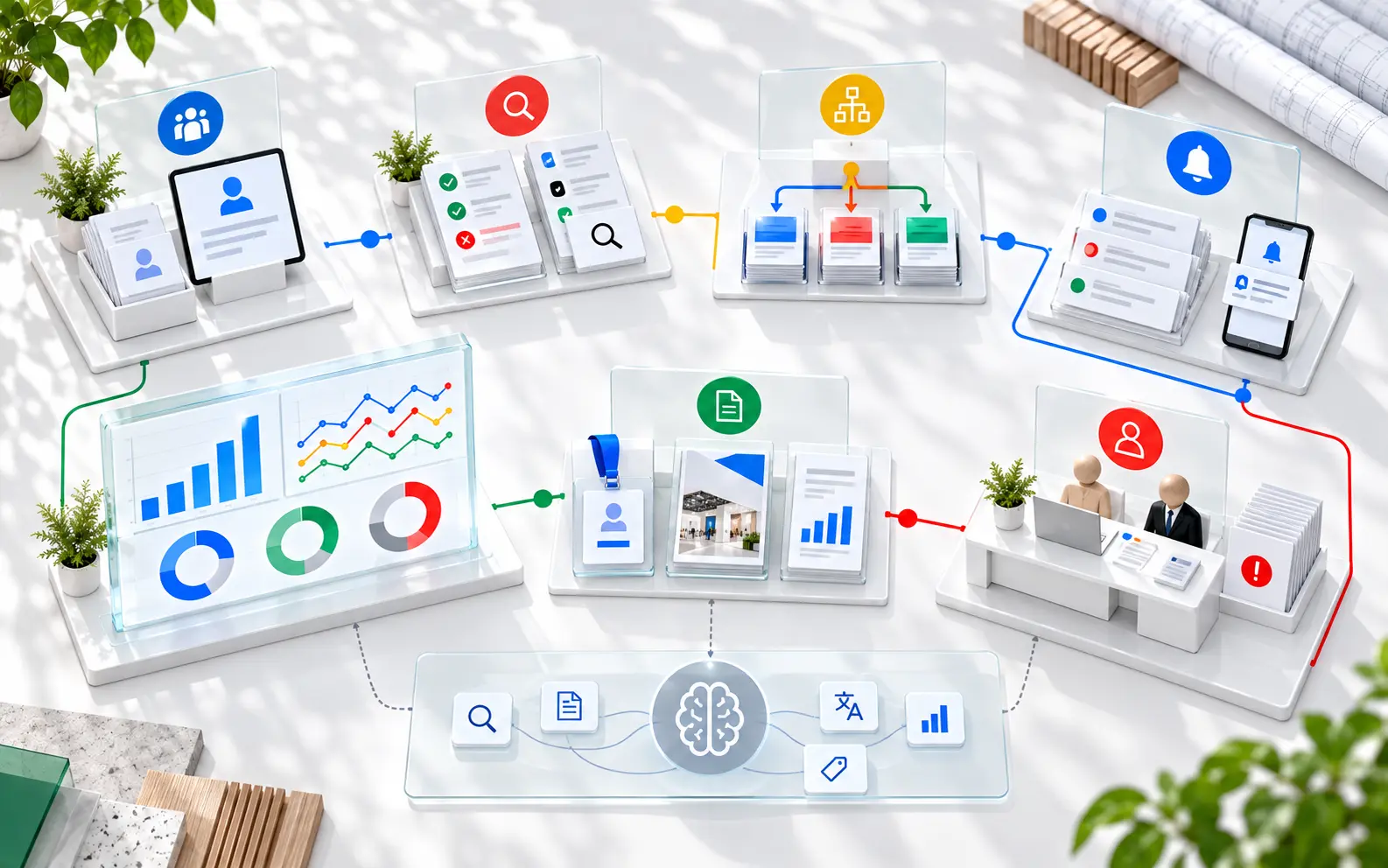
Automation uses agreed rules, triggers and status changes to move repeatable work forward. It can reduce the need for teams to repeatedly check files, copy information between systems or remember every follow-up manually.
System scope
Intelligent assistance
Artificial intelligence can add an assistance layer to well-defined exhibition processes. Depending on the context and available data, it may help summarise and translate information, classify submissions, search knowledge, identify missing or conflicting data, support relevant participant matching, prepare draft communications or surface patterns for review.
AI is most useful when its task is clear, its output can be evaluated and it complements the experience of the people responsible for the event. It should not be used to hide an unclear process or to make consequential decisions without appropriate human judgment.
Practical value
These improvements are not automatic. Their value depends on the quality of the underlying process, data, integration, adoption and operational ownership.
A proportionate response
Simplify workflows, strengthen data structures, remove unnecessary steps and make current systems easier to operate.
Plan reliable information exchange between existing systems when replacement is unnecessary or would create avoidable disruption.
Design and build an appropriate specialised solution where the operational requirement cannot be met effectively by the existing environment.
Responsible systems
Registration, accreditation, matchmaking and service systems can involve personal, commercial and operational information. Privacy, security, access control, data quality, transparency and retention therefore need to be considered from the beginning.
AI-assisted functions also require defined purposes, appropriate testing, human oversight and a clear understanding of their limitations. Reliable systems make automation visible and keep exceptions, responsibilities and important decisions accessible to the relevant people.
Expooya’s contribution
Expooya can analyse exhibition processes and existing systems, structure requirements, plan appropriate solutions and support custom development, workflow automation, system-integration planning and continuous improvement according to the agreed assignment.
The work begins with the operational objective, users, responsibilities, constraints and existing environment—not with a predetermined product. The resulting recommendation may be to improve, connect, automate or develop, depending on what the exhibition genuinely requires.
Research basis
This page’s perspective is informed by evidence on AI task fit and productivity from the OECD, the NIST AI Risk Management Framework, and European Commission guidance on data protection by design and by default.